 Ελληνικά
What is varicocele?
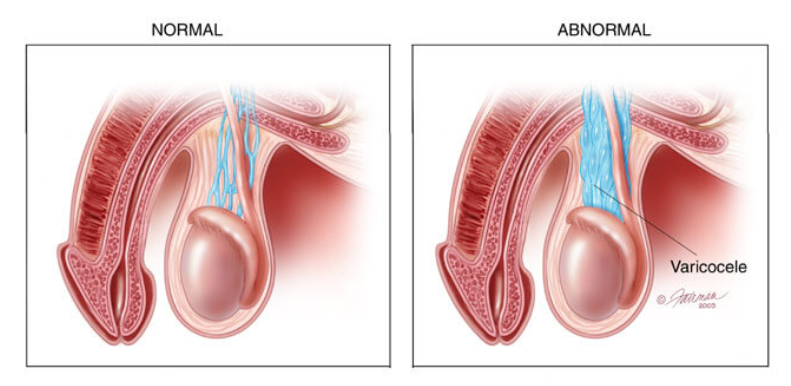
Varicocele is an enlargement of the veins of the scrotum — the loose skin bag that holds the testicles. Varicocele is like a varicose vein that can swell in the leg; it is a common cause of low sperm count production and decreased sperm quality (motility), although not all cases of varicocele affect sperm production. Varicocele can also cause shrinkage of the testicles due to impaired blood supply.
Most cases of varicocele develop over time. Fortunately, most cases are easy to detect and, if they cause symptoms, can be surgically corrected. Rarely, it can cause pain. The pain can vary from discomfort — a feeling of heaviness mainly on an abrupt change of position from sitting to standing, or with physical exertion, especially for long periods of time.
Over time, varicocele may grow larger and become more noticeable.
When to see a doctor
Because varicocele usually causes no symptoms and is often discovered during a fertility evaluation or routine physical exam, if you experience pain or swelling in your scrotum or discover a mass in your scrotum, contact your doctor. Some conditions can cause scrotal swelling or testicular mass or pain, some of which require immediate treatment.
It is not certain what causes varicocele, but many experts believe that varicocele is caused when valves in the veins of the seminal cord prevent blood from flowing properly. The resulting reflux is the cause of widening (dilation) of the veins.
Varicocele often occurs during adolescence, usually on the left side, most likely due to the location of the left spermatic (testicle) vein. However, varicocele in one testicle can affect sperm production in both testicles.
Complications of varicocele
Varicocele can cause:
Shrinkage of the testicles (atrophy)
Most of the testicle consists of tubules that produce spermatozoa. It's not clear what causes the testicle to shrink, but valve dysfunction with blood reflux resulting in blood stagnating in the veins can lead to increased pressure in the veins and exposure to toxins in the blood that can damage the testicles.
Infertility — how varicocele affects fertility
It is not clear how varicocele affects fertility. Proper circulation in the arteries and veins of the testicles helps maintain the right temperature for optimal sperm production. By inhibiting blood flow, varicocele can keep the local temperature very high, thus affecting the production (formation) of sperm and its movement (motility).
What can you do before meeting with the doctor?
- Write down any symptoms you are experiencing, including those that may seem irrelevant to why the appointment is scheduled.
- Write down basic personal information, including about recent life changes.
- Make a list of all the vitamins, medications, and supplements you take.
- Take a family member or friend along if possible. Sometimes it can be difficult to capture all the information provided during a meeting — someone accompanying you can remember something you forgot.
- Write down questions to ask your doctor.
Questions to ask your doctor
- What causes my symptoms or condition?
- Apart from the most likely cause, what are the other possible causes for my symptoms or condition?
- What kind of tests should I do?
- Is my condition temporary or chronic?
- Will this affect my fertility?
- What is the best course of action?
- What are the alternatives you propose?
- I have other health problems. How can I best manage them together?
- Are there any restrictions one should follow?
In addition to the questions you have prepared, feel free to ask questions that arise during your appointment.
What to expect from your doctor
Your doctor is likely to ask you some questions, such as:
- When did symptoms start?
- Are your symptoms continuous, or occasional?
- How severe are your symptoms?
- Is there anything that improves your symptoms?
- Is there anything that seems to worsen your symptoms?
What you can do in the meantime
Avoid physical exertion if possible. Take a light painkiller and wear a sport support to relieve pressure.
Your doctor will perform a physical examination, which may reveal a swollen, tension-free mass above your testicle that may be described as a bag of worms. If it is large enough, your doctor will be able to palpate it. If you have a smaller degree of varicocele, your doctor may ask you to stand, take a deep breath and push it towards the abdomen (Valsalva manoeuvre). This helps your doctor detect the enlargement of the veins.
If the physical examination is inconclusive, your doctor may give you a colour scrotal ultrasound. This test, which uses high-frequency sound waves to visualise accurate images of structures within your body, can be used to ensure that there is no other cause for your symptoms — such as a tumour compressing the spermatic vein.
Contents
Book an Appointment
Dr. Mertziotis specialises in the diagnosis and surgical treatment of varicocele using modern minimally invasive techniques.
Book an Appointment Online +30 210 6465359